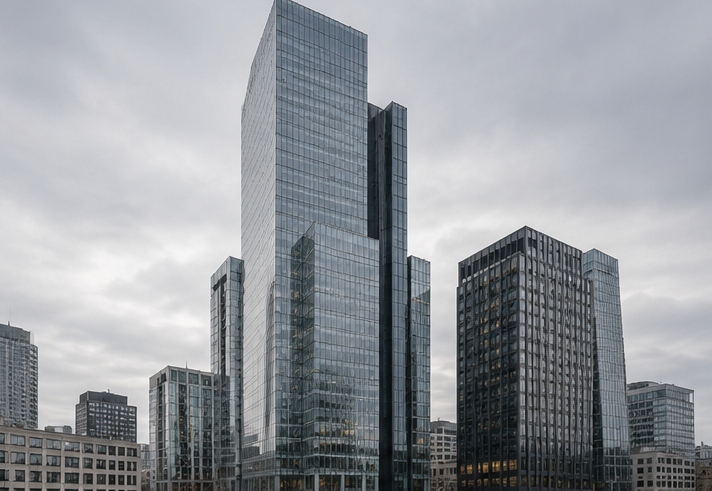
Every meter in every camera is trying to answer a question you did not ask. It wants to know what would make the whole frame average out to middle grey, and it will cheerfully wreck a facade to protect a cloud you do not care about.
This matters most with concrete, which is why I keep coming back to it. Raw concrete sits about a stop and a half above middle grey when it is clean and dry, and up to a stop below when it is weathered and wet. Those are very different materials wearing the same name, and a meter reading the whole scene cannot tell them apart.
The meter is not your friend
An evaluative meter is a committee. It takes the bright sky, the dark doorway, the mid-grey wall, and proposes a compromise that satisfies nobody. On an overcast day the sky can be four or five stops brighter than a north-facing wall. Hand that range to a committee and the wall goes muddy — recoverable in a raw file, but never quite the same as getting it right.
What I want instead is a reading of one surface, chosen deliberately, with a known relationship to middle grey. That is all spot metering is: a way of asking a smaller, answerable question.
Pick the surface that matters
Before raising the camera, decide which surface the photograph is about. In an architectural frame it is usually the principal material plane — the facade, the soffit, the floor slab. Meter that, then place it where it belongs:
- Clean dry concrete — about +1⅓ stops over the meter reading.
- Weathered concrete — roughly +⅔, sometimes dead on.
- Wet concrete after rain — often −⅓, it is darker than it looks.
- White render in shade — +2, and watch the highlight shoulder.
These are starting points, not laws. The value of writing them down is that you stop re-deriving them on site, in the cold, while a client waits.
Let the sky go
Here is the part people resist. If the wall is correct and the sky blows out to paper white, the photograph is usually still fine — often better. A blank sky reads as a graphic field, and a graphic field is a perfectly respectable thing to put above a building.
A protected sky and a ruined wall is a bad trade, made automatically, thousands of times a day.
Working journal, 2024
The exception is when the sky carries information the picture needs — weather moving through, a cloud edge that repeats the roofline. Then bracket, or wait. Waiting is cheaper and usually better.
A working routine
On site this collapses into about fifteen seconds of thinking, which is the whole point of having a routine at all:
- Name the surface the picture is about, out loud if necessary.
- Spot meter it, filling the spot with that surface only.
- Apply the offset from the list above.
- Glance at the histogram for clipping in that surface, nowhere else.
- Shoot. Do not re-meter for the next frame unless the light moved.
That final rule saves more frames than the other four combined. Light changes slowly on an overcast day; photographers fidget quickly. Trust the reading until something in the world actually changes.
None of this is novel — it is Zone System thinking with the arithmetic filed off. But it survives contact with a client standing behind you asking whether we are nearly done, and that is the only test that matters.